

From Artwork to Leather: How Western Boot Patterns Are Positioned Before Stitching
2026-08-13
Western boot decoration begins long before the sewing machine starts.
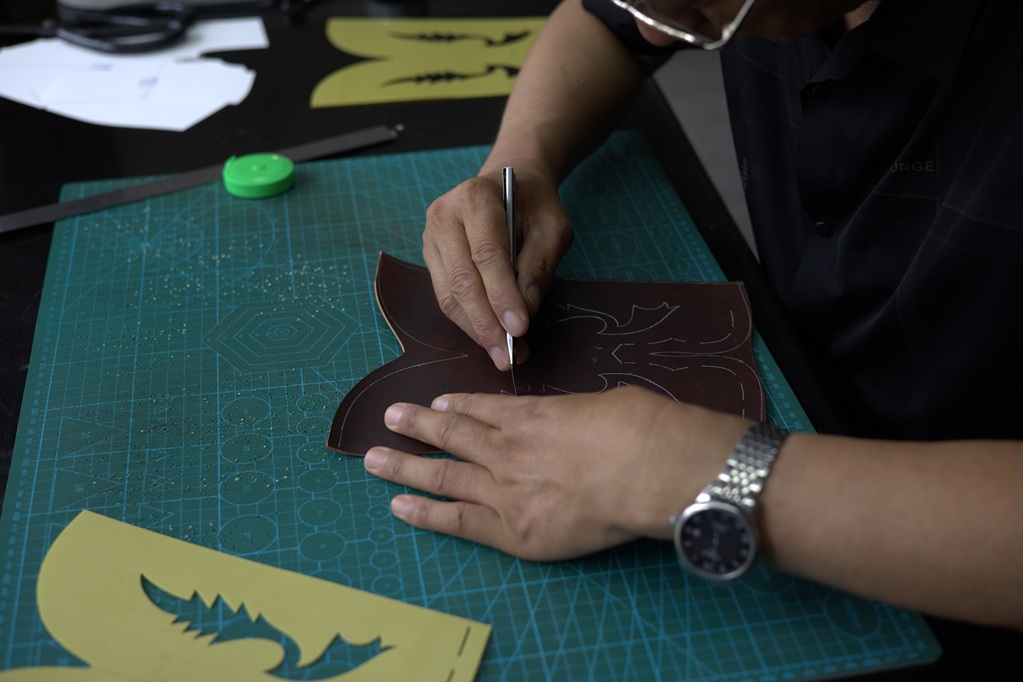
The image shows an early preparation stage in which a pattern is transferred onto a leather panel using a template and hand marking. This process gives the production team a clear reference for where embroidery, decorative stitching, or other design elements will later be applied.
Boot shafts are three-dimensional once assembled, but the artwork is first positioned on flat leather pieces. That creates an important design challenge. A motif that looks centered on a flat panel may shift visually after the leather is curved, stitched, and shaped into the finished shaft.
For this reason, pattern placement is reviewed in relation to panel boundaries, seam locations, pull straps, shaft height, and the overall direction of the design. Left and right boot panels also need to correspond so that the pair maintains a balanced appearance.
Templates help translate digital or hand-drawn artwork into repeatable production references, while manual positioning allows technicians to respond to the actual shape and grain of the leather.
At Jiangsu Yibei Industry Co., Ltd., this preparation step connects design development with manufacturing. By confirming placement before stitching begins, the team can better preserve the intended proportions of the artwork and prepare the leather for the next stage of production.
Turning a drawing into a Western boot is not simply a matter of copying lines. It requires understanding how those lines will behave once the leather becomes part of a three-dimensional product.
Boot shafts are three-dimensional once assembled, but the artwork is first positioned on flat leather pieces. That creates an important design challenge. A motif that looks centered on a flat panel may shift visually after the leather is curved, stitched, and shaped into the finished shaft.
For this reason, pattern placement is reviewed in relation to panel boundaries, seam locations, pull straps, shaft height, and the overall direction of the design. Left and right boot panels also need to correspond so that the pair maintains a balanced appearance.
Templates help translate digital or hand-drawn artwork into repeatable production references, while manual positioning allows technicians to respond to the actual shape and grain of the leather.
At Jiangsu Yibei Industry Co., Ltd., this preparation step connects design development with manufacturing. By confirming placement before stitching begins, the team can better preserve the intended proportions of the artwork and prepare the leather for the next stage of production.
Turning a drawing into a Western boot is not simply a matter of copying lines. It requires understanding how those lines will behave once the leather becomes part of a three-dimensional product.